
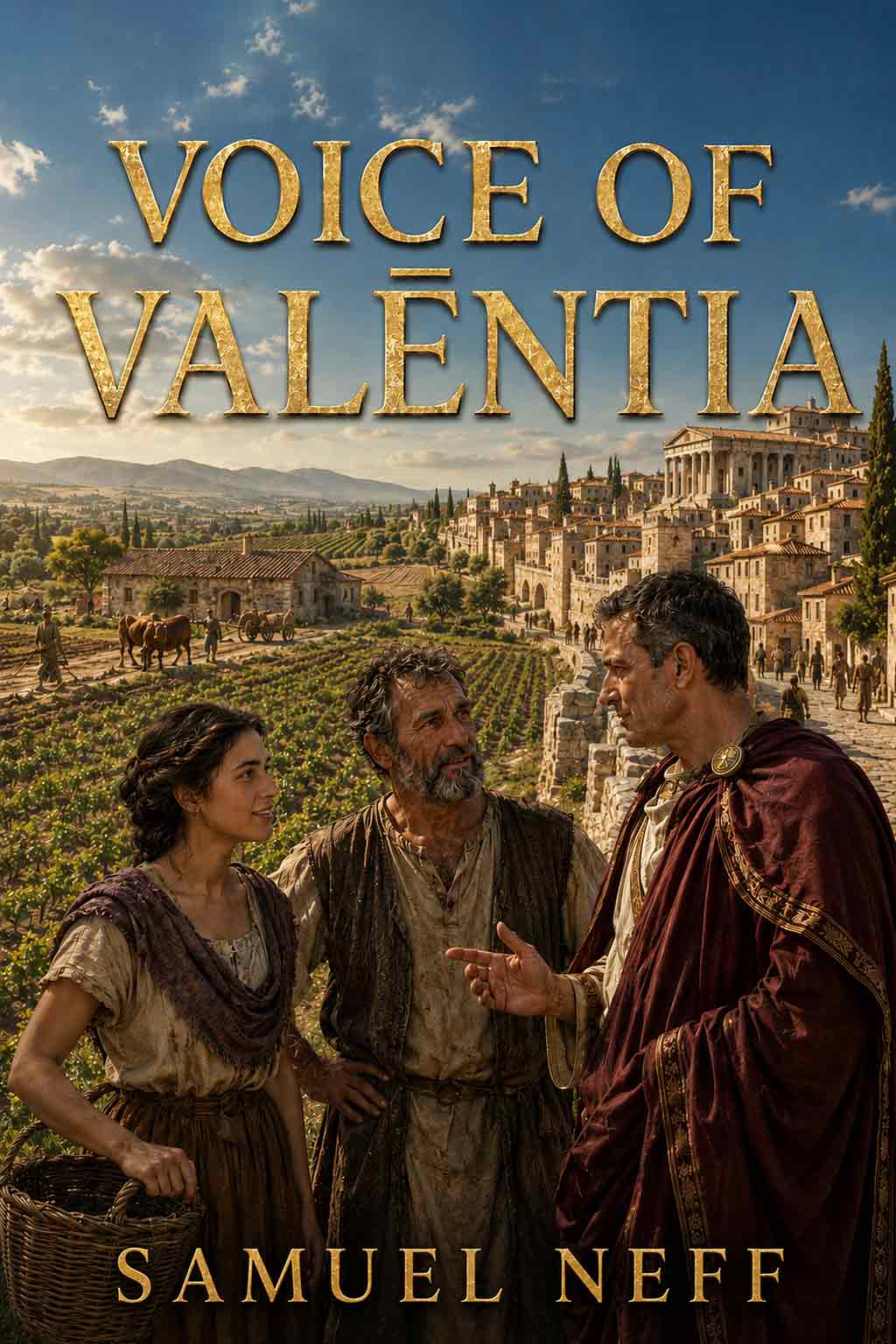
Voice of Valēntia
At the crossroads of Roman rule and Valeēntian subjects, Valeria not only translates words but cultures, laws, and meaning. All-the-while dancing around her own romance and the pitfalls her actions could uncover.
Historical Fiction
In the early years of Roman rule in eastern Hispania, power rarely announced itself with force. It arrived instead by road and tablet, by assessment and notice, by men who spoke in a language many of the countryside did not fully understand. Land changed hands not with swords, but with measurements; lives shifted not with decrees shouted from walls, but with phrases read aloud once and never repeated.
Between those who ruled and those who endured stood people whose task was not to decide, but to explain.
Valeria, the daughter of a Roman veteran and an Iberian woman, lives in that narrow space. She speaks both tongues fluently. She understands Roman law well enough to render it faithfully, and local custom well enough to know when the two must be harmonized. She holds no office, commands no men, and claims no authority of her own. Yet again and again she is present at the moments when something becomes final, when lives change.
Through the daily life of estates outside Valēntia, through mills and fields, tax notices and boundary lines, marriages negotiated as carefully as land transfers, Valeria’s life unfolds. Meanwhile, to be worthy of her, Quintus, a close childhood friend and second son, must build something of his own despite the quiet tensions within families where inheritance, duty, and reputation pull in different directions.
As Roman administration tightens its grip and local resentment grows, Valeria’s voice becomes increasingly visible. What begins as routine explanation turns into quiet advocacy, then into something more dangerous: testimony. By the time Rome itself must ask whether its officials have overstepped, Valeria is no longer merely translating words. She is translating actions, intentions, and responsibility.
The history of Valēntia is not a story of rebellion, nor of reform. Rome does not fall, and injustice is not undone. It is a story about how systems preserve themselves, how order is maintained, and how individuals learn the limits of what clarity can accomplish.
Valeria does not change the world. What she changes is smaller, and therefore more dangerous: the moment when power must explain itself. In a land where authority depends on being understood, her voice becomes a point of balance—sometimes a shield, sometimes a blade, always a record. When language and culture divide, a strong woman needs to bridge the gap.